Sunday, August 18, 2013

Build a Fishing rod? - Why build when you can buy?

Building a fishing rod is not for everyone.  Buying is faster and even inexpensive rods these days are of good quality.  So why bother? To me it’s an accomplishment that can’t be enjoyed by just anyone.  I enjoy the process, the planning, the craft, the results, and the great feeling I get when I catch a fish with a rod and fly I created – something that has no price tag.

I first got the building bug watching my Dad.  He was a great father, fisherman and builder – a craftsman actually.

My Dad - a few years before I arrived

Dad considered himself a “cabinet maker.” He could do anything with wood – from remodeling a room to building furniture to building a boat to building a house, two for our family and many more throughout his career – including the electrical and plumbing.  And, lovingly creating a cradle for his grandchildren. 

Boat being built by my Dad  - again before my time
And, of course, he also built a fishing rod.  A fly rod to be exact – a kit from Herter’s. 
He fished with a 9’ hollow steel fly rod and a 7’ split bamboo fly rod most of the time, but after re-tying several guides on the steel rod and letting me use the bamboo, he bought a new fly rod – an 8’6” Shakespeare Wonder Rod, FY 300 – comparable to an 8 weight today. 

Two of my Dad's fly rods grace a wall in my den

Both rods are older than I am - Dad taught me to fly fish with the Bamboo (top) when I was 10.  
But the Shakespeare was a bit heavy for everything, so he built a nice little trout rod.  He really enjoyed using a tool that he created, and felt justifiably proud when he caught a fish with equipment of his own construction.  (BTW – I still use both of those rods)

His enjoyment in creating, using and being successful with something crafted with his own hands was always apparent when we fished together and that spirit stayed with me. 

I built my first rod over 35 years ago and in the next 10 years made about 3 dozen for friends, family and myself.  

Eddie Heller, circa 1985 - the man that took pity on me and taught me everything I know about ice-fishing and fishing for smallmouth bass and brown trout on the NYC watershed system.  The fish are brown trout Eddie caught on the Croton Falls Reservoir.  The rod he's holding is one I made for him - a small token of my great appreciation for his friendship.

My Daughter Kristin, age 2, on her first fishing trip fighting her first fish - a 15" largemouth bass.  Along with the bass, she caught several yellow  perch and white bass.  She's using the first of two rods I made for her.  A third rod, an 8', 6 wt.  fly rod is in the planning stage.
But, using my basic math skills, it’s been about 25 years since my last rod project – too long. 

I built my favorite fly rod from a Don Phillips, one of a kind, 4 weight, 9’6” solid boron fiber blank in 1983 and have caught everything on it from panfish to trout to a 39” Chinook Salmon in the Devil’s Lake fork of the Wilson River in Oregon on a size 6 natural Teeny nymph I tied. 

I've repaired my Don Phillips rod twice – once when the top three inches broke off and again about three years ago when the boron fibers started to separate.  I had to call Don – currently a fishing writer in Florida – for consultation on that one.

The rod still works great, but I don’t want to use it till it disintegrates, so I thought it was time for a back-up rod.  Plus, I recently took an interest in Tenkara fly fishing and Spey and Switch fly rods. 
Tenkara is another story, although I did build a couple rods – sort of.  James and Kristin will understand.

Tenkara flies I tied - note the forward facing hackle.
Spey rods are the very long –  15’ and longer  – two handed fly rods first developed on the River Spey in Scotland for Salmon fishing.  Spey rods were gaining popularity for Steelhead fishing on the west coast back in the 1990’s, and I've seen some in Western NY lately.

Spey Casting -  Photo Courtesy  moldychum.com

Pete Humphreys casts with his spey rod. 
The Spey casting technique is fascinating, but the rod is really long and a bit unwieldy and highly specialized.  Thus – the Switch rod – which is coming on strong.  Typically about 11’, most of them can be used with the two handed Spey casting techniques as well as switching to traditional one handed casting depending on the situation. Thus the name “Switch”. 

Orvis has two excellent lines of Switch rods and whenever I’m at the Eastern Hills Orvis, I check them out.  Adam S. at Orvis is really an expert.  He’s been very helpful explaining the Switch rod techniques and the line and reels that go into making a complete outfit.  And there’s the rub – while top quality, a complete Orvis Switch outfit is way out of my budget.  So, while I save my nickels and dimes for an Orvis, I found a switch rod kit I could afford now till I can afford my Orvis. 

5 wt. 10' 6" switch rod components - the tape marks the guide position and spine of the rod.  My first rod project in way too many years is ready to start!
$55 plus shipping and a couple new spools of thread (the 2 dozen spools I had were just not quite the right color) and fresh Flex Coat for protecting the guide wraps, and I had a new 5 weight, 10’6” switch rod – after about 16 hours of work - over 3 weeks .  

It’s amazing how much you can forget about rod building after 25 years.  This 5 wt. is too light for steelhead, but it's designed as a backup for my 4 weight.  And at $55 a shot – my next one will be an 8 weight. Of course if I wait another 25 years to build it – well let’s not even go there!

So, here it is in a brief (finally) pictorial of going from component to complete. 

A few notes so I don't lose my way!

A small selection of my thread collection.

Fortunately, I kept my tools and this chart for proper spacing of guides.

After the base wrap, the guide goes on.  Three basic guides - the Snake guides (pictured here) for most of the rod, plus Stripping Guides and the tip top. 

The wraps have no knots.  the tag ends of the thread are looped and pulled under the last few wraps on the guide as shown here.

Shown above is a cotton twine "spacer" to snugly attache the reel seat.

After the guides are wrapped, they need to be protected.  Two coats of Flex Coat do the job.  The rod needs to be rotated until the Flex Coat is dry - 6 - 8 hours. Shown here a basic wrapping rack and motor to rotate the rod till dry.  I made the rack and several other tools for rod building back "in the day!"

FINALLY!  All done and ready to go!

I'm using my classic Orvis Battenkill Mark IV - 30 year old reel on a brand new rod - perfect combination!
The next photo of my 5 weight Switch will include a fish!

Thanks for stopping by!  See you on the water!

Dave 


Saturday, August 3, 2013

Get to know Lake Erie Summertime Smallmouth Bass


Capt. Ron, Joe and I have fished together many times, and it’s always a new adventure.
 
A couple of weekends ago was the first time the three of us were able to get out together on Capt. Ron’s new boat.  Most of the time we go for Walleye and occasionally for Bass and Perch.    


Capt. Ron, but that ain't no perch - yep, it's a Salmon.


Me (about 10 years ago on Capt. Ron's other boat) with a pair of Walleye.


Joe and Smallmouth
 This time smallmouth bass was the quarry and for the first time I decided to bring a fly rod. 

I’ve caught many largemouth bass on a fly, but I’ve never had the chance to fly fish for smallmouth.  I’ve tried on Lake St. Clair and on Erie, but the wind didn’t let me get a fly in the water.

We launched at Sturgeon Point and turned left to try the usual places.  This time there was little if any wind (and it was close to 90 degrees) so I rigged up my 9 weight and tied on my version of a Murdock Minnow. 
 
High hopes for my version of a Murdock minnow.

 Capt. Ron and Joe rigged up spinning rods with drop shot rigs using crawfish or chubs – both good smallmouth choices.

Reports were not encouraging.  Fish were scattered from 15’ to 40’ of water.  We tried it all, moving frequently with no luck.  After a couple of hours we decided to head back toward Sturgeon Point.  

There was only one other person fishing in the area, so we slowly moved within speaking distance. 
The lone fisherman was Mark.  
 
Mark - sitting on a Lake Erie hotspot near Sturgeon Point.

 Mark was anchored on a hot spot.  He said that in a couple of hours he caught 4 sheepshead and six smallmouth bass all around 18”.  He also fished the same place the night before and had caught a lot more – the night time smallmouth bite was on.

Mark was very helpful – he told us where and when and what he used.  He also said that he was leaving and we could pull up in his spot.  He was also kind enough to give us his remaining crawfish – his bait of choice.  He also said that the way to go was with an ultra-light rod, with the hook at the end of the line (as opposed to a drop shot rig with the sinker on the end) with two split shot about 18 inches from the hook and 18” apart.

Capt. Ron and Joe decided to stay with the drop shot and Joe tried a tube rig also, but I thought that I know enough to know that I don’t know it all - know what I mean?

I also brought a casting rod with a medium light tip – very sensitive with plenty of backbone to set a hook.  So I rigged up the way Mark told us and also took the advice of my favorite Oregon Fishing Guide, Dick O’Brien.  He often said that the best fisherman in the boat is usually Rodney – Rodney Rodholder.  Put the rod in Rodney’s grip and he’ll catch a fish for you.

So, with Mark’s rig on my casting rod I lowered a chub to the bottom and gave my rod to Rodney.  That way I could continue to ply the depths with my fly rod.

The Murdock minnow was replaced by a DFB laser ice minnow, my Con Fly, and then a goby imitation.  Nothing.  

 
DFB Laser Ice Minnows

DFB Con Fly
 
DFB Goby Imitation


While I was switching flies, Rodney was doing his job – my casting rod doubled over and when I picked it up I was fast to a smallmouth.   
After a good fight and several jumps Joe put the net under a 4 pounder.  


Me and one of my three Lake Erie Smallmouth Bass.

 Rodney did his job with Mark’s rig three more times (landed 2 of ‘em and lost one) while Capt. Ron and Joe enjoyed the show.

By this time I knew there were smallmouth down there and I was determined to get one on my fly rod.   

So, I finally switched to a black bucktail streamer I tied for smallmouth after reading an article in In-Fisherman about how great black bucktail jigs were for smallmouth.

Black Bucktail flies - with dumbbell eyes and unweighted in foreground.

 I was using a 600 grain sinking shooting head to get down to the bottom.
 
We were anchored, but there was enough current that to get down to 25' I had to let out about 60' of line.

 And finally, I had a hit!  It wasn’t as powerful as the earlier smallmouth, but after a brief struggle, I landed my first Goby (yes - Goby) on a fly.  As I said – always an adventure!

My first Goby on a fly - I'm so proud!
Many thanks to Capt. Ron for driving the boat and to Joe for netting my smallmouth, and to Mark for sharing his knowledge and bait.  I hope we run into Mark again on the water – he’s a really great guy who knows his fishing and is willing to share his knowledge – not a common thing!

Next for me is preparation for late summer trout by tying some Trico spinners 
and looking forward to Fall Salmon on Oak Orchard Creek.

Thanks for stopping by!

See you on the water.

Dave


Saturday, July 27, 2013

Prehistoric Monsters cruise the depths of Lake Erie

Several weeks ago, my friend Steve emailed a photo to me of his cousin on a beach on Lake Erie posing with a Sturgeon.  


Lake Sturgeon beached at Lotus Bay on Lake Erie (New York)
This specimen of an ancient species of fish had washed ashore on Lotus Bay after meeting its unknown demise.  This Sturgeon is a Lake Sturgeon. 

From Wikipedia:
“The lake sturgeon (Acipenser fulvescens) is a North American temperate freshwater fish, … Like other sturgeons, this species is an evolutionarily ancient bottomfeeder with a partly cartilaginous skeleton, an overall streamlined shape and skin bearing rows of bony plates on its sides and back, resembling an armored torpedo.”  http://en.wikipedia.org/wiki/Lake_sturgeon

Here’s another photo that was circulated last year on the internet labeled as a Lake Erie sturgeon. 


An impressive "Monster" - Yes - Lake Erie - NO.
This was truly a Monster – but not from Lake Erie.  I saw the same photo in In-Fisherman magazine  and it was a White Sturgeon caught on September 19, 2005 in the Fraser River near mission, B.C.  It was slightly over 11 feet long.

The Snake River in Idaho is another excellent place for Sturgeon.  They frequently use 12” – 15” Rainbow Trout for Sturgeon bait on the Snake.

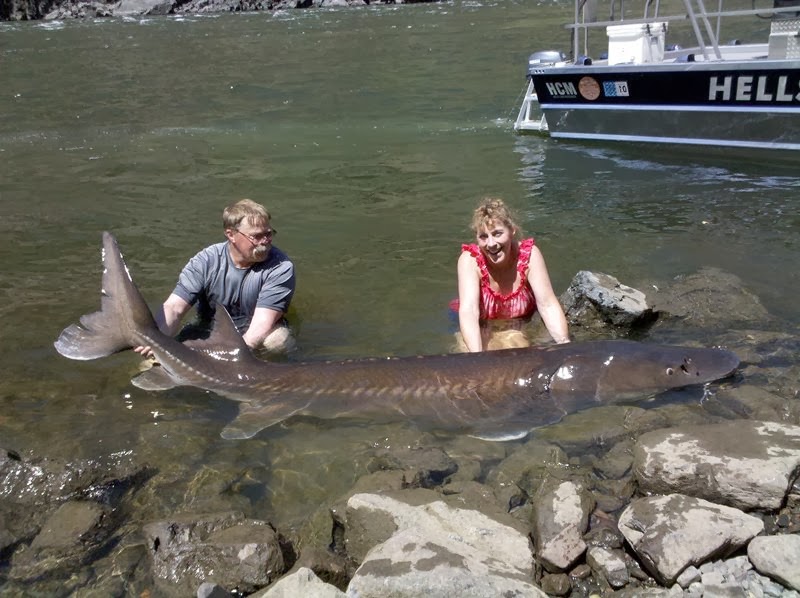
Large White Sturgeon courtesy www.snakeriversturgeonfishing.com 

Here's another photo of a Snake River Sturgeon caught near Payette, Idaho in 1911.  


"Back in the day," they used teams of horses to drag massive Sturgeon onto the shore in Oregon and Idaho
It was reported that a 2,000 pound Sturgeon caught in Oregon was mounted and exhibited at the Chicago World's Fair in 1893.  While I was born near Chicago - the Fair was just a bit before my time or I'd have a picture of that fish.

While it’s good to know that Sturgeon still reside in Lake Erie, it’s very sad to see one that should be in its prime of life, dead on the beach.  Lake Sturgeon were once abundant and thriving in the great lakes, so numerous they were even considered a nuisance and a trash fish that was used as fertilizer or dried and burned as fuel in the steamboats that once plied Lake Erie. 

However, once the value of sturgeon was realized, over harvesting soon decimated their numbers to a point where it is a rare occasion when one is caught or even seen washed ashore.  Currently, there is no open season for Lake Erie Sturgeon and possession is prohibited.

The story is quite different on the West Coast from Northern California to Washington and inland to Idaho via the Columbia and Snake Rivers.

When I lived near Portland, Oregon I frequently fished for White Sturgeon – one of some 26 species of fish in the family Acipenseridae.   http://en.wikipedia.org/wiki/White_sturgeon

My daughter Kristin, a "shaker" Sturgeon she caught, and me on the Columbia River near Horse Tail Falls.
Most of my Sturgeon fishing was in the Columbia River from Bonneville Dam downstream to where the Willamette River enters the Columbia.  While my largest Sturgeon was just over 5 feet long, I have seen Sturgeon considerably larger rocket out of the water within about 10 feet of my 17’ boat.  

And, one of the Fishing Guides on the Columbia guarantees a Sturgeon of at least 10 feet long or your next trip is free.  In the 7 years I lived in Oregon, he never gave away a single trip.

Here are a few more photos of Columbia River sturgeon, fishing from my 17’ Bayliner using typical terminal tackle – no dry flies for sturgeon!


My neighbor Neil with a small Sturgeon - note the tubular mouth it uses to vacuum food from the bottom.
In the earlier photo of Kristin's fish, the mouth is closed and 
the tube is not visible.

Neil's son with his first Sturgeon

Slider to allow Sturgeon to take the bait without feeling the sinker

Terminal tackle - cannon ball sinker 8 oz. up to 2-1/2 lbs (shown) or larger, in fast water, 8/0 Barbless hook snelled with 120 lb Dacron line - mono was too stiff and Sturgeon have sensitive mouths, and a Quarter to call someone and tell them you caught a sturgeon - this was before three cell phones on every boat!

Here's one getting ready for the smoker!
While Lake and Atlantic Sturgeon are in trouble, the West Coast has a thriving Sturgeon fishery.

The photo below shows a few of the 60,000 plus sturgeon, some up to 14’ long that formed a huge ball below Bonneville Dam on the Columbia in 2008.

“U.S. Army Corps of Engineers - Thousands of sturgeon - some 14 feet long - mass below Bonneville Dam in this video frame from a remotely operated submersible sent down to investigate what was first thought to be a pile of rubble. The "Mighty 86th Beavers" on the screen refers to the Army dive team operating the submersible, and the number 55.2 is the water depth in feet.”
More from the Army Corps of Engineers - "We call it the big sturgeon ball," Schwartz said.

“The mountain of white sturgeon contained around 60,000 fish, according to a crude estimate by Michael Parsley, a research fisheries biologist with the U.S. Geological Survey's Columbia River Research Laboratory in Cook, Wash. He described that estimate as "probably conservative."

It was an aquatic phenomenon nobody had ever seen at such a monstrous scale, offering a startling glimpse into the life of the Columbia's largest and most ancient fish.”  

Click this link (or copy and paste in a browser) to view the video: http://blog.oregonlive.com/breakingnews/2008/05/_when_sonar_surveys_spotted.html

Many thanks to Steve and his cousin for sending me the photo of the Lake Erie sturgeon.  It brought back many great memories of fishing in Oregon. 


If this reminds you of a special or unusual fishing story – 
I’d love to hear it, and see the photos.

Thanks for stopping by – Good Fishing!


Dave

Monday, July 8, 2013

Chautauqua Lake Bass, Catfish and Blackened Shrimp

Which of the above don’t belong in the title?  

If you guessed Blackened Shrimp you’d be dead wrong!

You’d also be wrong if you guessed Bass or Catfish. 

The key is where to find these “tre amici” (three friends in Italian).  

Fortunately – I was lucky enough to find all three at Chautauqua Lake.

My daughter Meghan was home from NYC for the Independence Day weekend.  It was the first time for a long time that her schedule and the schedule of her sister Kristin and that of my wife and me allowed us to take a family road trip.

One of the areas we've never been to is Chautauqua Lake.  Hard to believe since it’s one of the traditional top fishing destinations in the state.   My wife, Joyce, heard that the Chautauqua Institution was a place that needs to be on everyone’s bucket list.  I knew little about Chautauqua Institution except that it was an international community for art, theater and intellectual endeavors – so, I devised a plan to go fishing while the family got some culture!

I thought I’d bring my inflatable kayak, fly rod and a couple hundred flies and try my luck!

Guess how long this will decorate my family room?
After coming to my senses, I realized that every time I tried to combine fishing with a family trip it was a disaster.   Family trips are great – family fishing trips are great – but never the twain shall meet!

So now, I’m waiting to see how long Joyce will let me leave the kayak in the family room – anyone want in on the pool?

But I digress – We got a late start – typical for us – made a wrong turn at Tim Hortons, and finally got to Chautauqua Institution about 1:30 pm.  Since we were late, we didn't stop at M&T for cash – we had $10 combined – but ATM’s are everywhere - right?  However, the one at Chautauqua Institution was out of service. 

We looked around the visitor center and collected about a ton of brochures for places to visit in the area.  Then we noticed that to get into the Chautauqua Institution, it would cost $8 to park and $13 per person just to walk through the gate!  

I’m not a math major, but for a family of four, that looks like a $60 bill to walk around a place just to see what it looks like. 

Among the brochures was one for Bemus Point – just on the other side of the lake – lots of quaint shops, art galleries, food, drink and ice cream – and no parking or cover charges! 

We hit the road and zipped over the Route 86 bridge and were soon in the picturesque village of Bemus Point.  We followed Main Street to the water’s edge where we were greeted by the Italian Fisherman.   

Fine Casual Dining!
By this time it was about 2:30 pm and after taking a look at a couple of shops, we were all ready for lunch.  The Italian Fisherman Restaurant was right there inviting us in.  The first decision was which level for lunch?  Upstairs, downstairs at the water’s edge or out on the water at the Italian Fisherman’s Water Grill – a floating restaurant!  

On the Water at the Italian Fisherman
We picked the middle ground and settled in on the deck for a fabulous lunch.  

We're in the right place to be Hungry!
Meghan opted for the Bourbon Walnut salad and grilled chicken, Joyce and Kristin went for the gourmet burgers and white truffle parmesan fries, and I went for the Blackened Shrimp with NY Cheddar grits. 

http://www.italianfisherman.com
I love shrimp – I love blackened seasoning – learned from many meals in the Big Easy, and grits – well, two out of three ain’t bad!   But, I soon learned that the Italian Fisherman knew their grits!  Absolutely fantastic! I've been converted!  The Blackened Shrimp were the best I've ever tasted!

BEST EVER Blackened Shrimp and NY Cheddar Grits!
And the fries – their white truffle parmesan fries are the only fries EVER that I did NOT need an application of ketchup!  Honest!  And, the burger was also delicious – Joyce never finishes a meal so I typically get at least 1 and a half.

The atmosphere was outstanding, the food was to die for, the service and staff was incredible – but don’t take my word for it – go there and see/taste for yourself – one of the best restaurant experiences we – as a family and individually have ever had!  www.italianfisherman.com

And – on the way out, I met the manager, Jade, and told her of our wonderful time, while whining about not being able to go fishing.  She promptly told me that her 10 year old son, Simeon, loves to fish and showed me a couple photos of his very first fishing trip.  

Simeon and Bass - Crank Bait and ultra lite rod

Simeon and catfish - First trip - this kid's a Natural!
He’s way ahead of me – at his age all I’d ever caught was a tiny blue gill! I hope I can talk him into telling me where to fish if I can get back down to Chautauqua Lake.  But, until then, Simeon will keep the fish nervous and I’ll plan my next trip – fishing and eating – to Chautauqua Lake and the Italian Fisherman!

Fishing and food just go together – anyone out there have a story and photos to share?
Good fishing and eating!

Dave